 HackerTube.runGood videos, with context.
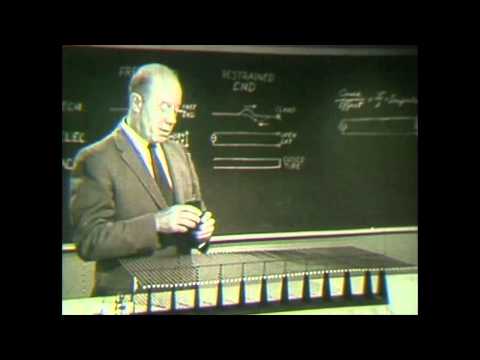
AT&T Archives: Similiarities of Wave Behavior (Bonus Edition)
About this video
A Bell Labs film in which Dr. J.N. Shive uses a mechanical wave machine to demonstrate reflection, standing waves, resonance and impedance matching. He includes some equations but relies mostly on real-world examples a layperson can follow.
Why it appears in the archive
HN repeatedly calls it the clearest introduction to waves and transmission-line behavior, better than modern explainers.
AI-generated summary and labels from the source dataset; verify important details against the video. Source & credits.
From the Hacker News discussion
I'm even jealous of the engineering students that came before me! :P Visualization is such a powerful tool. I didn't really understand waves until I saw "Similarities of Wave Behaviour" [VIDEO]
Read original comment ↗I've never understood why these old instructional films so often seem much better at getting things across and making them stick in my mind than more modern material. A couple other examples. 1. A 1959 film from Bell Labs on wave behavior that made standing wave, reflections, energy loss due to impedance mismatch, and impedance matching much clearer than anything else I've seen: [1]. 2. A 1937 explanation of how the differential in a car works: [2]. Here is another upload of that which is lower resolution, but has more from the same source in the sidebar [3]. I suppose it could be something akin to survivorship bias that makes old educational films seem so good--the bad ones don't get remembered 60 years later. [1] [VIDEO] [2] [LINK] [3] [LINK]
Read original comment ↗Bell Labs' 1959 video "Similarities of Wave Behavior." By far the best introduction to the subject of waves of any sort. [VIDEO]
Read original comment ↗This outstanding 1959 movie from Bell Labs demonstrates standing waves, impedance matching, and more in a very nice way using a couple of Shive wave machines, hosted by Dr. Shive himself [1]. [1] [VIDEO] [2] [LINK]
Read original comment ↗This very old video does it all explain better than all todays videos. The models are just so simple, no animations. [VIDEO]
Read original comment ↗Thinking of an electron as a thing that travels from the start of the circuit to the end results in a bad mental model. Think of it as a wave, and then watch this video [VIDEO] . Then you will have a strong mental model.
Read original comment ↗Get a ham radio technician license, and you may develop an intuitive perspective on most electrical engineering concepts. i.e. the physics lab derivation of the core EE tool set is unnecessary if you understand what the models are describing. AI is slop in and slop out... and dangerous to students... =3 John Shive's Wave Machines is where every student should start: [VIDEO]
Read original comment ↗It is not "hard" after some practice, but you need to be willing to learn. In general, DFM is a specialized area most EE have zero training in unless they chose to study it as an option. John Shive's Wave Machines is where every student should start: [VIDEO] Remember to have fun =3
Read original comment ↗