 HackerTube.runGood videos, with context.
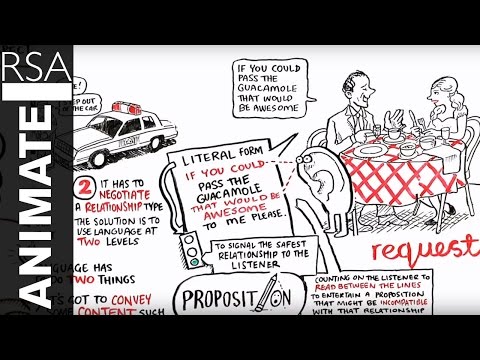
RSA ANIMATE: Language as a Window into Human Nature
About this video
An RSA Animate in which Steven Pinker explains how the mind builds infinite meanings from finite language, and why people often speak indirectly. It covers ambiguity, politeness and mutual knowledge, including the emperor's new clothes example.
Why it appears in the archive
HN recommends it as a short, clear explanation of why people avoid saying things explicitly and how common knowledge works socially and politically.
AI-generated summary and labels from the source dataset; verify important details against the video. Source & credits.
From the Hacker News discussion
It sounds like the ambiguity of it all is a feature, which makes me think of this wonderful RSA Animate of Steve Pinker's discussion of how we use language: [VIDEO] I have a feeling a lot of the insights of this talk also hint at why something ta'arof can be useful to a human society.
Read original comment ↗I was talking about something similar earlier today with a friend from high school. We were talking about how it was totally un-cool to disagree with the "consensus" about which girls were hot and which were not. We were imagining what it might have been like if we'd felt able to speak our minds. I'm not a huge believer in the whole "social media toppled authoritarian regimes" stories that have been going around after Tunisia/Egypt but I do think that to the extent real anonymity is possible it has the potential to help people living in places where dissent is both stigmatised and punished by allowing them to realise that others feel the same way. This Steven Pinker talk [VIDEO] (I think; I don't have Flash so can't check it's the right one) talks about why this type of communication is essential to free societies and why freedom of assembly is protected in all free societies. On the same general topic researchers in public health give people some wiggle room on truth telling by introducing random noise into their responses in order to improve the aggregate quality of information you get from asking them questions about controversial topics (drug use, sexuality): [LINK] tl;dr: anything that helps people tell the truth rather than timidly conforming to social norms is a good thing
Read original comment ↗You make a very reasonable but demonstrably false assumption about language: that it is all about A trying to communicate an idea to B, as clearly and as efficiently as possible, and all involved are cooperative. Reality is often much more complicated. Take the simple example of A talking to B with listener C. There's the scenario where a A wants to talk to B but without being understood by C. Or the reverse where A wants C to understand something but not B, whilst talking to B. And we can go on like this - see for example, this[0] RSA Animate by Steve Pinker about why we don't just say things explicitly most of the time. As a result of all this we get stuff like jargon, coded slang, read-between-the-lines expressions, and yes: foreign languages. Because if you apply that insight to human groups, it becomes obvious that with human "tribes", the use of language is as much a way of excluding outsiders as it is about clear communication. In this light, stuff like youth slang always evolving into something unintelligible to adults makes perfect sense. As long as there is a desire for selecting who doesn't understand you (which I think will always be the case), language diversification will be a thing. If you have access to New Scientist articles, this one[1] sums it up nicely [0] [VIDEO] [1] [LINK]
Read original comment ↗> the vast majority of people might actually wish for rebellion, but none of them actually acts out on that wish. You're talking about Mutual Knowledge[0]. Basically, the Emperor's New Clothes scenario: I know the emperor is naked, but does everyone else know and do I want to risk myself finding out? This short Stephen Pinker video[1] explains it really well: [0] [LINK] [1] [VIDEO]
Read original comment ↗OP's condition said it was social anxiety than social awkwardness to which my post was asking for a more overall solution to social issues. To answer your question, I think his sessions were pretty beneficial but I think missed one thing that I believe therapists should be aware, some socially awkward people are oblivious. There's body language [0], there's ways of talking about or asking for things (don't do it directly sometimes) [1], etc. Some people can't magically overcome that when meeting people but I believe they can learn (at risk of exacerbating their self-consciousness). [0] How Do You Use Body Language to Read Minds?; [LINK] (It's said to be inaccurate, I'm not sure either) [1] RSA Animate - Language as a Window into Human Nature; [VIDEO]
Read original comment ↗If the sole effect of voting is to choose a winner, then you're probably right. But I think that's not the only effect that comes out of counting the votes. It's the one place where voters actually lay their cards on the table, or rather cast their votes in the ballot box. Votes are not a limitless resource to voters, unlike words or even opinion polls, and it is an important form of communication to other voters in the next election. This is where gaming the voting system hurts democracy. Simply voting for the biggest bloc that is not your vision of pure evil is short-sighted, and causes the voters lose their independence - important for a voting system to arrive at an optimum result [1], and it also destroys the only credible method of communicating the lack of confidence in the system to each other [2]. Everybody knowing that everybody else knows that everybody have lost faith in the main blocs is not sufficient to create real change, but it certainly is necessary. [1] [LINK] [2] [VIDEO]
Read original comment ↗No, anonymity by itself won't save you, though can sharply decreases the odds of getting caught if you are careful. What anonymity does instead is probably the most important part of starting any movement that is mutually exclusive with "acceptable" political views. When a political situation starts to work against the interested of the common person, most people tend to notice, at least in some small way. If nothing else, they notice some of the harmful effects that are starting to affect them. As they (greatly) outnumber the people "in charge", they only need to use their strength in numbers (either politely with the vote/etc or violently with the pitchfork and molotov. Unfortunately, this can be prevented by creating a situation where people fear retribution and fear that any action they take will not be successful. When you believe that not enough people would join you or that there is no way you to achieve that critical mass of people, learned helplessness sets in. It becomes "obvious" that "fighting corruption is futile", when it really is as simple as everybody simply trying . This is why the 1st Amendment has a right to assembly , and why "free speech zones" and other obvious abridgements of that right were important to fight. It's also why a lot of people in power got very, very scared at the "Occupy" movement. People assembling so they can see first-hand that they are not alone in their views is one of the only ways to undo the learned helplessness. It is hard to ar
Read original comment ↗> As I read Pinker, I sometimes imagined a book published in 1923 about the astonishing improvements in the condition of Europe’s Jews following their emancipation. Such a book might argue: look, obviously past results don’t guarantee future returns; all this progress could be wiped out by some freak future event. But for that to happen, an insane number of things would need to go wrong simultaneously: not just one European country but pretty much all of them would need to be taken over by antisemitic lunatics who were somehow also hyper-competent, and who wouldn’t just harass a few Jews here and there until the lunatics lost power, but would systematically hunt down and exterminate all of them with an efficiency the world had never before seen. Also, for some reason the Jews would need to be unable to escape to Palestine or the US or anywhere else. So the sane, sober prediction is that things will just continue to improve, of course with occasional hiccups (but problems are solvable). > Or I thought back to just a few years ago, to the wise people who explained that, sure, for the United States to fall under the control of a racist megalomaniac like Trump would be a catastrophe beyond imagining. Were such a comic-book absurdity realized, there’d be no point even discussing “how to get democracy back on track”; it would already have suffered its extinction-level event. But the good news is that it will never happen, because the voters won’t allow it: a white nationalist autho
Read original comment ↗