 HackerTube.runGood videos, with context.
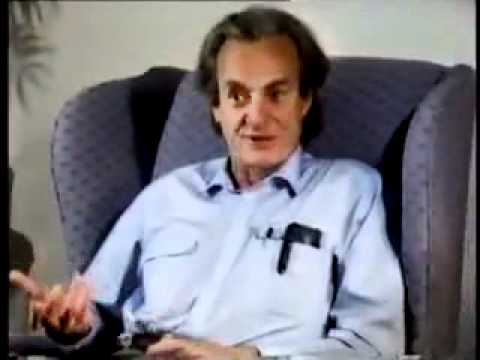
Richard Feynman. Why.
About this video
A short clip of Richard Feynman answering an interviewer's question about why magnets repel, explaining that a 'why' question depends on a shared framework of understanding. It illustrates how hard it is to explain fundamentals to a layperson.
Why it appears in the archive
Cited constantly as the classic answer to 'why' questions, on explanation, frames of reference and the limits of physics.
AI-generated summary and labels from the source dataset; verify important details against the video. Source & credits.
From the Hacker News discussion
And we can actually listen here Feynman's answer to " what is the meaning of... " and " why " questions: [VIDEO] Note, despite the title of somebody presenting this segment of his talk, he definitely doesn't talk just about "magnets" but really about "the meaning" and "why" questions (the youtube poster got it). About the needed "expected framework" to avoid "perpetual why questions" etc. Even the things that we take for granted, e.g. using electricity in our day to day life, or the eventual "why" we don't fall through the floor can't be properly explained using just our "common" intuition. In another direction, it works, we are "used" to see some effects of the electrical forces all the time, so that's what is "intuitive" to us because we're familiar with it. So back to the original title of the article submission here: "why ... shrugged off the paradoxes..." it can be easily seen that once one is getting an answer inside of the expected framework, one doesn't "shrug it off," one is actually satisfied with the answer.
Read original comment ↗It's not simple thing to explain non simple things in a way that it's comprehensible to a layman. I think this video is a very good illustration of this fact [VIDEO]
Read original comment ↗Regarding "fully" understanding physics, I like to refer people to Feynman's answer to a question about why magnets repel each other[0]. "Assuming something" is one integral part of the scientific method. You formulate a question, you build a hypothesis from prior knowledge, you make predictions, you test them, you analyze your results which might lead you to change your hypothesis or not. "Greatness" is finding simple hypotheses (like "the laws of physics are the same as viewed from any inertial frame and the speed of light is the same for every observer") that predict/"explain" effects that were inconsistent with prior hypotheses. Of course you can never really prove a model of the world is correct - another model that predicts differences that are too small for us to measure might be the "truth", but, until we can measure it, there isn't much use in pondering ... [0] [VIDEO]
Read original comment ↗There's a really good clip by Richard Feynman on explanations and frames of reference: [VIDEO] I think he does an excellent job of explaining why it's so hard to explain this type of thing.
Read original comment ↗Richard Feynman addresses a similar "why" question in a great way in this interview[1], and how "why" questions are problematic in science. [1]: [VIDEO]
Read original comment ↗DNA is neither hardware nor software, living organisms aren't computers. Bad analogies are going to frame your thinking and may prevent better understanding. They'll also set you up for fruitless discussions with people who don't like the analogy. Somewhat related: (Richard Feynman - Why) [VIDEO]
Read original comment ↗Makes me think of this talk by Richard Feynman talking about magnets how do they work. [VIDEO] The take away is to answer a why question you need a framework to provide an acceptable answer. Why the universe exists? We don't have possibility can't contain such a framework.
Read original comment ↗Richard Feynman himself has a reply similar to yours in the documentary called "Fun To Imagine" when he is asked a why question, in that case related to the magnetic force: [VIDEO] Indeed, questions of why are often metaphysical and can't truly be answered within the framework of physics.
Read original comment ↗