 HackerTube.runGood videos, with context.
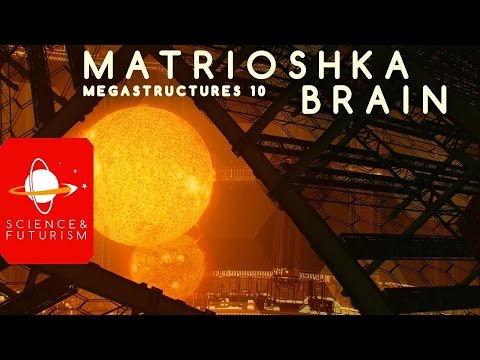
Matrioshka Brains: Star-Powered Computers
About this video
Isaac Arthur explains the Matrioshka Brain, a hypothetical computer or artificial mind powered by an entire star using nested shells. It covers how such megastructures relate to Dyson spheres and superintelligence.
Why it appears in the archive
HN points to it as the accessible introduction to Matrioshka Brains whenever very large computational structures come up.
AI-generated summary and labels from the source dataset; verify important details against the video. Source & credits.
From the Hacker News discussion
This is one argument as to why we don't see any ET life. Once they reach a sufficient level of technology, instead of going outward, they go inward. Creating Matrioshka Brains and living in virtual worlds. Here's a video by the excellent Isaac Arthur: [VIDEO] Another one by Joe Scott: [LINK] If it indeed turns out that we are living in a simulation, then I guess the question then begs. Why not live in a simulation of your own rules and making? What would be so wrong with that?
Read original comment ↗> Consciousness is an emergent property of computation It's interesting to see the negative comments about this here because I agree with you. "Consciousness" or even "sentience" is notoriously difficult to define. Even defining what an organism is isn't entirely obvious (eg some might consider a colony of ants or bees as being organism-like). Our views tend to be extremely human-centric because we can relate. I imagine once we actually invent an AGI many will debate if it's truly sentient or conscious for a long, long time afterwards. > Computation is more efficient in smaller, less massy media There are physical limits on computation. A smaller package ultimately has a lower limit. That alone will (IMHO) keep a space for very large computational units. At the top end of this is Matrioshka Brains [1]. A digital existence looks highly likely in the black hole era of the universe [2]. This is the era after all the stars have faded out and will be much longer (based on current understanding) than the stellar era, so much so that the 13-14B year lifetime of the universe thus far will be like the blink of an eye. As for detecting communication, that's too narrow a focus. Whether we're miniscule cyborgs that communicate with qubits or living as virtual beings in a world-sized computer, the ultimate limits of what any such civilization can do is is the amount of energy they can consume. More energy means more is possible. So even if we end up living as a K2 civilization in a billio
Read original comment ↗Let me introduce you to Matrioshka Brains [1]. It's not quite what you suggest. In this case it's one (or more) successive shells around a star to use the solar output into computing power. The amount of computing power you could get from this is simply unimaginable. This structure would have similar properties (and honestly isn't really that different to) a Dyson Swarm. Assuming thermodynamics holds the only way to get rid of heat ultimately is to radiate it away into space. At any temperature you're likely to get to this is going to be infrared light. The wavelength of radiated heat is solely determined by temperature. So could you instead radiate away visible light? Technically, yes. Kind of. One way is simply to use a lot less of the energy. Now could you get the temperature up to where this has a visible light signature instead? You're talking about thousands of degrees. What material could get that hot? It's a big problem. Also, such a material will still have telltale signs. Spectroscopic signature would reveal it wasn't the expected hydrogen-helium mix. Another possibility is a truly giant star. Stars can get incredibly large. IIRC the largest known star (UY Scuti) if it were placed at the Sun's position would be large enough to swallow Jupiter. The thing is. These supergiants/hypergiants don't have a hostile boundary or surface in the same way a cloud from a distance looks solid. It would be hot but really diffuse. Technically it would be possible to build within the
Read original comment ↗