 HackerTube.runGood videos, with context.
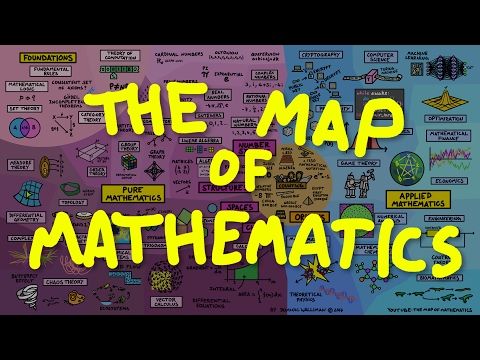
The Map of Mathematics
About this video
An animated 11-minute tour of the whole field of mathematics as a single map, showing how pure and applied math and their sub-fields relate to each other.
Why it appears in the archive
Recommended to people asking how to self-learn math as a quick bird's-eye overview of the field.
AI-generated summary and labels from the source dataset; verify important details against the video. Source & credits.
From the Hacker News discussion
I'd start with this video to get an overview of all the topics and areas that mathematics entails (some might be unknown to you) [VIDEO] . Then you go ahead and research a bit what sounds interesting to you and then you might google that topic and add "foundations" to that google search. It's just that most school/university math is heavily focused on analysis and algebra but there is so much more!
Read original comment ↗I suggest this "Map of mathematics" as a starting point that gives you a reasonable birds-eye view of the field. [VIDEO]
Read original comment ↗This is a much more entertaining map of mathematics in about 10 minutes [VIDEO] For a history of mathematics NJ Wildberger's lectures are easy to listen to. [LINK]
Read original comment ↗> shift this burden to the medium This is beautifully expressed. Knowledge consists of connections across concepts but those connections are rarely shown explicitly in textbooks. Even wikipedia, while allowing you to traverse the connections back and forth easily, does not do a great job of giving you the bird's eye view of a subject or a field. Check out this "map" of mathematics: [VIDEO] Every subject needs a similar map. Besides visualizing the connections, we'd also need interactivity to the topic that helps with forming new mental models - which is the core aspect of learning. Jupyter notebooks, ObservableHQ, Mathigon are some of the good projects working on this aspect. Disclaimer: I am building the open-source project [LINK] which is attempting to build the complete map of knowledge/skills. So I too am biased against books and in favor of digital/interactive tools.
Read original comment ↗This is a good map of Mathematics to get an overview of where you can go... [VIDEO] Then Giles McMullen-Klein has an awesome recommended list for data science (your mileage may vary). [LINK]
Read original comment ↗I agree with other comments that "learn maths" is too broad. You can take a university degree in maths and still be just at the beginning of "learning maths." I recommend refining your goal somehow: perhaps to learn math related to certain applications that you're interested in, or learn math in a certain area (e.g. high-school algebra, geometry, probability, discrete math, graph theory, calculus, pure math, abstract algebra, topology, etc). If you have not mastered high-school algebra and other pre-calculus subjects, you should start there; most other maths subjects will assume that you know these things. Calculus takes up a lot of space in upper high-school and early university courses -- but if you're a developer there may be other subjects that are more immediately useful to you (e.g. discrete math, linear algebra). I set out to "learn maths" (that's verbatim what it says on my personal Kanban board). In the end I took some university classes. For me they provided the structure and teachers to help me learn. Also, there is a difference between having an idea about what some math-thing is, and being able to pass an 3 hour closed-book exam in that topic. I agree that Khan Academy is a good learning resource that will provide structure to your learning: [LINK] Purplemath is another good resource: [LINK] YouTube is full of videos of people running through problems on any conceivable topic. Definitely search there for help. Once you've worked your way through the high school p
Read original comment ↗This is a general issue i have seen as well. We live in 2018 and there is no open source course for everything. Instead there are probably 10-30k universities who have similar courses and professors who give the same lecture every year. They get paid often enough by countries to create and do those courses. In germany most of our unversities are paid by all of us germans anyway. And what do you find online? Always the starter verion like 101 computer science or videos with bad audio or video, no proper exercises, no solution helper etc. Nothing. You have to go to different sites to sometimes pay or sometimes not. there are no local locations to meet up with people. There should be a global initiative for global free and open access learning. Sponsored and supported by companies and countries. Build upon a core of a knowledge graph based on topics or 'snippets of knowledge'. Like for example: math -> add -> sub Something like 'The Map of Mathematics' ( [VIDEO] ) And when you wanna get the global accepted math 101 level, you have to take specific topics / snippets. And those snippets can than be filled with different people who are making a lecture for that topic and you can choose whom you like more or who is better in explaining it to you. What do i do instead? I ask around for the lecture scripts because they are always behind a simple password protected area or have multiple links to different pages of different universietses who offer different courses for free as videos f
Read original comment ↗The educational youtube channel Domain of Science has a pretty wide-scope Map of Mathematics, depending on your background [VIDEO]
Read original comment ↗