 HackerTube.runGood videos, with context.
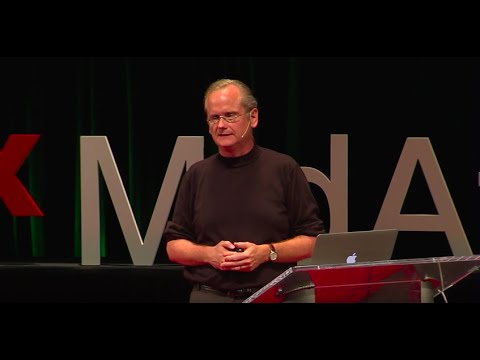
Our democracy no longer represents the people. Here's how we fix it | Larry Lessig | TEDxMidAtlantic
About this video
Harvard law professor Lawrence Lessig argues that US democracy is corrupted by money, since a tiny fraction of the population effectively funds who gets elected. He says fixing this must come before addressing issues like climate change or student debt.
Why it appears in the archive
It is HN's go-to link in threads on lobbying, campaign finance and political dysfunction, as a clear statement of Lessig's root-cause argument.
AI-generated summary and labels from the source dataset; verify important details against the video. Source & credits.
From the Hacker News discussion
I've spent large amounts of time in other countries. America is an absolute embarrassment. There are countries you can go where it feels like the government actually cares about trying to help people have a better life. There are countries where infrastructure projects get completed. There are countries where infrastructure isn't just completed, it's good . There are countries where the administrative overhead of health care is 2% instead of (a likely underestimated) 25%. You can't fix infrastructure policy, or any other policy, in America without first fixing campaign finance reform. As long as senators and justices can be openly bought and sold there is no hope of getting responsible leadership that acts in the interests of citizens. Very good video explaining the core issue of American politics by Harvard Law professor and founder of creative commons Lawrence Lessig-- Our democracy no longer represents the people : [VIDEO]
Read original comment ↗The problem is that what we understand as theoretical democracy and what is generally practically applied on the ground are two philosophically different things. An anti-thesis of democracy itself. Prof Lawrence Lessig of Harvard nails it when he calls this type of corruption of democracy as Tweedism. Here's a quick summary of his thesis (2015): [VIDEO] Here's a longer, more academic, version (2014): [LINK] Both talks begin with the Hong Kong student protests of 2014.
Read original comment ↗Larry Lessig backs both net neutrality and democracy. See his plan for restoring democracy to the United States: [VIDEO] The main points are: 1) Citizen funded campaigns 2) Equal representation (ie, Proportional Representation) 3) Equal freedom to vote
Read original comment ↗Won’t matter. ‘They’ donate to both sides of the isle. Lessig has a good video that breaks a lot of this process down. [VIDEO]
Read original comment ↗Lawrence Lessig (Harvard law professor famous for fighting for sane copyright law) does a great presentation on the root cause of Americas problems. He also ran for president in 2016. It can be watched here: [VIDEO] The short version is that to win primaries you need money. Money mainly comes from corporations and rich people. Taking money from corporations and rich people creates a relationship where you have some loyalty to them or they can punish you if you don't act how they want. Thus the primary corrupting force in America is pro-corruption campaign finance laws. The test for democracy is whether elected politicians pass legislation that the public at large wishes to be passed. Our very own Princeton did a study to answer this question. The key finding: “The preferences of the average American appear to have only a miniscule, near-zero, statistically non-significant impact upon public policy.”[1] In a very real, non hyperbolic sense we are in a plutocracy where money rules. We are not a democracy due chiefly to our campaign finance laws. Here is a campaign that aims to work on this: [LINK] [1] [LINK]
Read original comment ↗Since you brought up 'free elections', I think this talk by Lawrence Lessig is relevant. "I don't care who does the electing, as long as I get to do the nominating" [VIDEO]
Read original comment ↗I think US politicians' failure to act effectively in the interests of US citizens is caused more by the concentration of political power than it is by bad people. The US isn't alone among developed countries in having this problem, but there are plenty of developed countries that manage to avoid it. The answer is more democratic accountability, in the form of measures such as proportional representation. This Jennifer Lawrence video summarises some desirable reforms: [LINK] See also Lawrence Lessig's "Our democracy no longer represents the people. Here's how we fix it": [VIDEO]
Read original comment ↗I see where you are coming from, but I still object. Based on all the problems in our system I don't know that the U.S. deserves to be called a democracy, unless the word has lost much of its meaning. Candidates are effectively preselected via funding by .02% of the population before people can vote, and gerrymandering districts is rampant so that political parties are selecting voters, instead of the other way around [0]. Would you say that things like that make the U.S. a de jure democracy, also? I think the problems with our so-called democracy explain why Trump has had the following that he does. He had the money and media experience to get elected based on the outrage so many people have for all other politicians who do not really represent them. The establishment seemed more interested in getting rid of him than addressing the sentiment that brought him to office. I'm not a Trump supporter myself, and I loathe his demagoguery, but I think that understand why he got elected. He's popular with a lot of politically apathetic people because they really believed he would "drain the swamp" and that he wasn't like every single other politician - not another Bush, not another Clinton, another insider, not someone who was going to bail out Wall Street again, etc. Apologies for nitpicking and spouting off a bit, but like I said this has all very much been on my mind lately. I know that I may be tilting at windmills here, but words are important and shape our thoughts, which led m
Read original comment ↗