 HackerTube.runGood videos, with context.
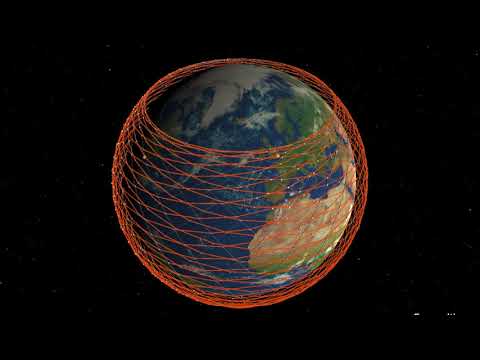
Starlink revisions, Nov 2018
About this video
Mark Handley of UCL looks at how SpaceX's November 2018 revisions to the Starlink constellation affect network behavior. The video visualizes the orbits and routing and estimates latencies, building on his earlier video and research paper.
Why it appears in the archive
HN points to Handley's simulations whenever Starlink latency comes up, as the best visualization of orbits and why laser links could beat fiber over long distances.
AI-generated summary and labels from the source dataset; verify important details against the video. Source & credits.
From the Hacker News discussion
this guy made an excellent youtube video modeling and visualizing the satellite orbits, the network routing paths across them, and the resulting latencies: [VIDEO] NYC to London on the current internet is 76ms, he shows it across starlink's updated plans as working out to around 46ms. Later in the description he points out a mistake in his own math and says that starlink paths should be 8.7% faster than the video shows, so really jfk<->lhr ~ 42ms.
Read original comment ↗The FCC filing has a lot of good technical details on the deployment and frequency usage. Additionally, Mark Handley has a good primer on it. It may kill actual east-west terrestrial traffic due to latency improvements: [VIDEO] North-South will still be terrestrial.
Read original comment ↗Here's some great visualizations of the orbits and an explanation of what it means that the orbits are optimized for the northern hemisphere. (This confused me at first since obviously any orbit has to go just as far south as it does north of the equator.) [VIDEO]
Read original comment ↗If you want a really great visualization and latency estimates for starlink check out the models and videos this guy came up with: [VIDEO] [LINK] The comment from the FCC about it not accounting for "processing [&] routing" is kindof nonsense on its face, those are not novel problems they're already done by ever other router and switch, including several other satellite networks.
Read original comment ↗Mark Handley has done a bunch of videos analysing this on his channel[0]. The TLDR is that there is a lot of room for Starlink to beat existing terrestrial options IF they can get the laser links working on-orbit. This video[1] shows estimates using what was known about proposed configurations in 2018 [0] [LINK] [1] [VIDEO]
Read original comment ↗There were recently two simulations done on possible latencies based on the FCC filings. You can find the video simulations in the links at the bottom of this post. You can see international links that have latencies lower than the existing internet by a significant margin. Unfortunately neither of those simulations take into account that the first iteration has been changed to only use radio and no laser links. [0]: [LINK] [1]: [VIDEO]
Read original comment ↗At 5:03 [1] he talks about how the laser links give good connectivity east-west but not as good north-south. [1] [VIDEO]
Read original comment ↗There's no doubt that this sort of technology can in principle deliver sub-100ms latencies. Take a look at my analysis here with inter-satellite links: [VIDEO] And here without ISLs: [LINK] Now, these videos assume no queuing delay. It's really hard to guarantee low queuing delay in a traditional IP network, but there's been a lot of research over the years, and we have a range of ideas that can be used to deliver minimal queuing with reasonable utilization. In fact doing this for Starlink is something I'm actively researching at the moment. I'm convinced it can be done, but it won't look like a conventional IP network internally. I don't know what SpaceX will actually do, so if the FCC has doubts, this is perhaps where they are concerned. Other delays might be in the ground segment, but that's more or less the same for SpaceX's terestrial competitors, and the FCC seems to think they can do it.
Read original comment ↗