 HackerTube.runGood videos, with context.
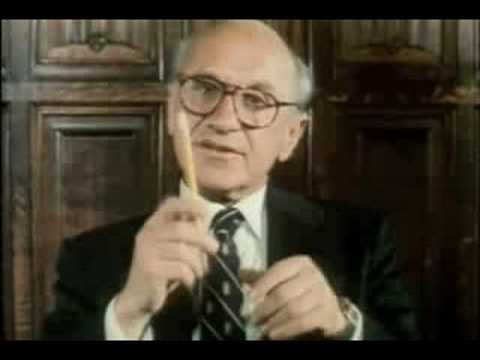
Power of the Market - The Pencil
About this video
A three-minute excerpt from Milton Friedman's Free to Choose in which he uses a pencil to show that no single person knows how to make it. He argues that the free market coordinates countless strangers peacefully.
Why it appears in the archive
HN uses it as the canonical illustration of decentralized production and global cooperation, often cited well outside economics threads.
AI-generated summary and labels from the source dataset; verify important details against the video. Source & credits.
From the Hacker News discussion
> "Do you mean that Boeing is built by independent people who work on whatever they want to and then a plane is assembled of that independently built parts and no one takes the responsibility of the result?" Somewhere in the middle. If you consider the work that goes into making a plane, you'll see quite a bit of it happens outside Boeing. To give one example, think of the aluminium that goes into the plane. Boeing doesn't have to mine bauxite, extract the aluminium from the bauxite, transport it to the place where its sold, etc... A classic example of this ground-up view was this example given by Milton Friedman about the pencil. I don't agree with many of his views, but I think he makes a good point in this video: [VIDEO] EDIT: Turns out the source of this example may have been Leonard Read: [LINK]
Read original comment ↗A GC grants economic freedom to indentured servants (H1B visa holders is the politically correct term). The longer freedom is denied the more profitable it is for the corporate masters. One of the tricks of this modern day slave trade is to lobby Congress to set a quota (about 30% of the demand) on the number of people who are set free each year. For the groups with the largest numbers of indentured servants, additional quotas are lobbied for. As long as the dollar was strong and life was shit in the third world hells these people came from, this system worked. The corporate masters recognize that the game is now up. The usual argument given for the lack of freedom for H1B visa holders is that the bureaucrats need to ensure that a H1B doesn't cause a job loss for a citizen. A pencil pusher doesn't even know what it takes to make the pencil [1] he is pushing, and yet somehow he can ensure that a citizen doesn't lose a job! The H1B visa is indentured servitude by the back door, plain and simple. Anyone who has given some thought to the idea of protecting jobs knows it is an exercise in futility (For a start, Congress must pass an Amish decree [2]: ban all technology invented since 1830, and declare Thomas Edison as the worst job destroyer [3] the world has ever seen. Also it will have to order the arrest and lock up of all entrepreneurs aka wannabe job killers, which is most HN readers). Therefore, I suggest to do away with all the current H1B bullshit, and adopt a point based
Read original comment ↗I too would be interested in studies. But I do think environmental cost is factored in to the cost of most things, especially if due to environmental damage it is no longer possible to get a Thing at any price. I think the true cost of a single pencil is well reflected. [VIDEO] The problem with the profiler analogy is that economic costs can open up economic gains, whereas wasting billions of cycles in a dumb loop opens up nothing. If you analyzed the human activities that produce the most environmental cost, the individual contributions would be nothing. Only when you look at economies of scale driven by collections of people do you get to anything remotely resembling significant numbers. And you might think "Let's ban all cars", since that's a somewhat noticeable effect in aggregate, but by doing so you would kill off many other parts of the economy. Depending on the reaction, it could be good or bad for the environment. It could be good if humanity went extinct and the costs we directly produce went to 0 (leaving only the 'natural' costs), but that's not a world I want to live in.
Read original comment ↗While Leonard Read's essay was reasonably well known among Chicago School economists, the concepts it described were made more famous by Milton Friedman's Pencil Allegory from the 1980s PBS series "Free to Choose": [VIDEO] You can read a critical article on the back story to Friedman and Read's writings on pencils here: [LINK]
Read original comment ↗> there is no self-sustaining city on earth Indeed. That's an other concept that I'm not sure Musk is fully aware of. Economies, industrial production systems are highly inter-dependent on Earth. In our "technological civilization", even to build something as simple as a pencil, you need lots of people collaborating from all over the planet [1]. So to me the idea of building a "self-sustaining technological civilization" on mars sounds quite ludicrous. 1. [VIDEO]
Read original comment ↗>You can't control for every variable in a market. It just isn't possible. Even economic "laws" like supply and demand have counter examples like Giffen goods. That's the whole point. Markets are decentralized brains, while Socialism advocates that a government as a central planner will be more efficient (it could be more efficient in specific cases like total war or natural disasters) and lead to Communism where we won't even need a government because society will behave as one being. The lesson of the pencil comes to mind: [VIDEO]
Read original comment ↗Maybe but if you reduce the population from whatever group, there is less needs for everything and because everything is related it will an worldwide impact. Watch this video: [VIDEO] and you'll see that all is linked and the more we are the more we will consume this planet.
Read original comment ↗Look at this lead pencil. There's not a single person in the world who could make this pencil. [0] [0]: Milton Friedman [VIDEO]
Read original comment ↗