 HackerTube.runGood videos, with context.
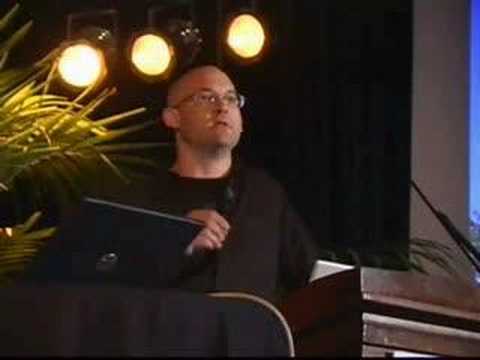
Clay Shirky on Love, Internet Style
About this video
A short Supernova 2007 provocation in which Clay Shirky uses a 1300-year-old Japanese shrine, rebuilt periodically, as a metaphor for how networks change business and collective creativity.
Why it appears in the archive
HN people cite it for the Ise shrine metaphor, that function rather than original material defines identity.
AI-generated summary and labels from the source dataset; verify important details against the video. Source & credits.
From the Hacker News discussion
"The little guy with the big knife is Tsunenori Iida. He speaks not as an individual but as an emanation, the present voice, of the generations whose blood flows in him and who held the long knife in lifetimes before him, just as he speaks of Masahisa as if he were the same Masahisa who wrought the first samurai sword, in the days of dark mist. Thus it is that he tells me he's been here since 1861, during the Tokugawa shogunate, when this city, Tokyo, was still called Edo." Reminds me of the metaphor Clay Shirky uses in his "Love, Internet Style" ( [VIDEO] ) speech. He talks about the Ise Shinto shrine, which the Japanese claim to be 1300 years old even though the building itself is rebuilt periodically. The Japanese think it is 1300 years old because the function of the shrine has existed for 1300 years, just like the function of this man has been around since 1861, even if he, the mere physical manifestation of this function, has not. Interesting way to think and define oneself.
Read original comment ↗Reminded me of Ise Shrine ( [LINK] ) and also Shirky's reference to it ( [VIDEO] ). The point there is that function is also a meaningful definition of is-ness. Besides, aren't all of the cells in a human body replaced every x years already?
Read original comment ↗You do realize that comes from english right? if $you-are-hungry { make-a-sandwich() } make-a-sandwich() if $you-are-hungry; If you remove all of the non-letter characters, you are left with very understandable english sentences. if you are hungry make a sandwich make a sandwich if you are hungry So unless english is a second language to you, it should be fairly easy to understand. If you pay attention to how people use those different forms in english, you will also notice that the infix form of “if” tends to be used for simple short sentences. Which is exactly how I use it in Perl and Raku. sub factorial ( UInt $n ){ return 1 if $n == 0; return 1 if $n == 1; return $n * factorial($n - 1) } Though I might consider using `when` instead. sub factorial ( UInt $_ ){ return 1 when 0; return 1 when 1; return $_ * factorial($_ - 1) } Of course a junction would be useful sub factorial ( UInt $_ ){ return 1 when 0|1; return $_ * factorial($_ - 1) } You are probably having fits with that to. The thing is, that also reads fairly well in english. return one when [it is] zero or one Often times in informal english the “it is” in such a sentence is left off for brevity. So I left it off, because we are obviously talking about “it" (`$_`). I mean, what else could we be talking about? I could easily see this being said as a response to another person. > Alice: What result should we give the user? > > Bob: Return one when zero or one. > Otherwise multiply it by … You are probably thinking th
Read original comment ↗I always thought the "made with love" taglines were inspired by the same Clay Shirky talk: [VIDEO]
Read original comment ↗