 HackerTube.runGood videos, with context.
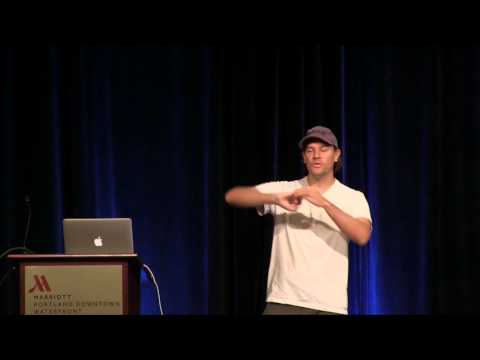
Bret Victor - The Humane Representation of Thought
About this video
Bret Victor's closing keynote at UIST and SPLASH 2014 argues that our tools for thinking ignore most of human sensory and motor capability. He sketches representations that engage more modalities beyond screens and keyboards.
Why it appears in the archive
HN treats it as a foundational Bret Victor talk that reshaped how people think about software and interfaces, often cited alongside Dynamicland.
AI-generated summary and labels from the source dataset; verify important details against the video. Source & credits.
From the Hacker News discussion
Really excited to go through all the other talks listed here I'm not familiar with! Three talks that I tend to reference a lot and have had a huge impact on the way I think about software: The Soul of Software: Avdi Grimm - [LINK] The Humane Representation of Thought: Bret Victor - [VIDEO] How to Program Independent Games: Jonathan Blow - [LINK]
Read original comment ↗It's going to be entirely different I feel. Instead of manipulating graphics on a flat screen, focus will probably be on manipulating physical objects on a table / in a room. Watch his 2 talks that highlight the thinking and inspiration behind the RealTalk project: [LINK] [VIDEO]
Read original comment ↗Highly recommend Bret's 2 talks for context: [1] Seeing Spaces: [LINK] [2] Humane Representation of Thought: [VIDEO]
Read original comment ↗One of the goals of Dynamicland is to foster the creation of new representations that take advantage of + live across more sensory modalities. Bret calls them modes of representation, but there are similar phrases in learning & psychology literature. Most representations are haphazardly created (math notation, periodic table of elements, etc) by (often) singular experimentation. Representations are poorly researched and understood (there's no branch of science dedicated to them). If representations were studied more closely, we could get much better at deliberately creating representations that are more humane. When the scientific method is applied, we can then apply the engineering method to create new things from those principles. Bret's talk is a great, accessible overview of these ideas from his context ( [VIDEO] ). To vastly oversimplify things, one way to improve accessibility is to parallelize representations that live in just 1 or 2 sensory modalities to all of our sensory modalities. This way, math notation could be made accessible to & equally powerful to the blind (as it is to those who can see). I empathize (a little, it would be naive for me to assume I can 100% empathize) with your reaction along the axis of accessibility. What Dynamicland looks like right now isn't what it's going to look like later. Right now, you may see Dynamicland as text boxes but now distributed in a room. In 50 or 100 years, there may be no text AT ALL and you can use the senses availabl
Read original comment ↗It just so happens I was thinking about spatial org just yesterday, that it would be so nice if I can have 'villages' of tabs on a (geographical) Map. Amazing co-incidence that I woke up to bonsai browser notification! You might find The Humane Representation of Thought[1] by Bret Victor[2] useful, where he demonstrates by example, how existing tools/software (generally speaking) doesn't utilize all the 'superpowers' that we acquired via evolution. --- [1]: [VIDEO] [2]: [LINK] Edit - grammatical fixes
Read original comment ↗For the people asking who is Bret Victor: When "What are your favourite tech talks of all time?" is asked on HN, he gets more mentions than anyone else, usually. Some of his talks: Inventing on Principle [LINK] The Future of Programming [LINK] The Humane Representation of Thought [VIDEO] Media for Thinking the Unthinkable [LINK] Seeing Spaces [LINK] Drawing Dynamic Visualizations [LINK] [LINK]
Read original comment ↗on one level, yes on another, they're down right scary and overwhelming, or at least dumbfounding and perplexing ..thinking specifically about The Humane Representation of Thought [VIDEO] I had to stop it half way through.. :-/ see also Seeing Spaces [LINK] and Media for Thinking the Unthinkable [LINK]
Read original comment ↗I had the pleasure of visiting Dynamicland and hanging out with Peter Norvig, Nicky Case and many others. There's a few things that stuck out for me: - The community! Most people I interacted with were pretty inter-disciplinary. Some came from an education heavy background, others from a more programming language background. Some from interface design, others from physical installation or video game background (and everything in between). Everyone had their own degree of skepticism but were excited by the discussions that were happening (a sign of a good research culture!). - The representations : What excites me the most about Dynamicland is that it's an environment for fostering unique representations of ideas. The cultural forces & ideas (social programming, remixing, visible state / code at all times, 3d environment, etc) baked into the space encourage the experimentation & creation of new ways of representing complex ideas. Some scattered examples here - [LINK] - Removal of artificial barriers : When programming on a computer these days, there's so many barriers to doing simple things. The amount of code that exists to do virtual actions in a virtual world is MASSIVE, and acts as a huge barrier. This is something Bret talks about at the end of his interview on Postlight ( [LINK] ). Because code / programs in Dynamicland are embodied in the room, you don't need code to move a dialog box or a slider around. You just moved it yourself. This is super powerful and it means yo
Read original comment ↗