 HackerTube.runGood videos, with context.
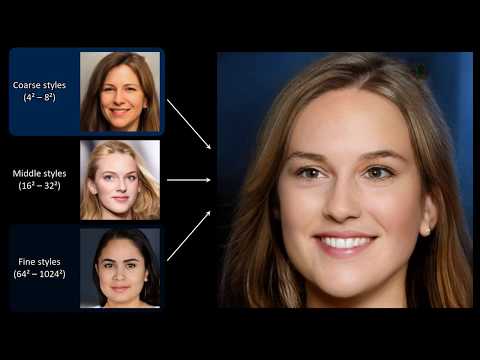
A Style-Based Generator Architecture for Generative Adversarial Networks
About this video
A short demo video for NVIDIA's StyleGAN paper, which proposes a style-based generator for GANs. It shows face synthesis with style mixing and scale-specific control over attributes like pose and freckles.
Why it appears in the archive
Cited as an example of how realistic GAN-generated faces had become, and of what a well-structured latent space can do.
AI-generated summary and labels from the source dataset; verify important details against the video. Source & credits.
From the Hacker News discussion
Note that isn't tabula rasa generation. All these faces are generated from reference images. See this timestamped video for example: [VIDEO] . Current deep generative tech requires a carefully designed dataset of images with controlled variation. For the faces above, a dataset of celebrity faces was carefully constructed from a larger wild dataset, so as to not have any rare features, and the eyes and noses were aligned, making the dataset digestible by a GAN. This particular method then also uses multiple style images which it takes certain features from to mix up and create the mixture face. The main problem with this tech is that the quality can not be reliably controlled. Whatever it generates has to be passed through a human checker/curator pretty much. You can't just serve up generations to the audience without checking what they are. So, imo, this tech would be very useful for the concert art stage of the creative process, being able to just create new things, or mixup existing things, but only to create an intermediate artifact, which would then be used as inspiration for the artists to create the final art. This is also devoid of any form of higher-level reasoning. It doesn't know concepts a human artist would know, such as object permanence, intuitive physics, etc. Something as simple as a ball falling down should squish a certain way, and when hit the ground should squash another way. It also doesn't have artistic sensibilities like anticipation, etc., that have be
Read original comment ↗Do you believe this kind of thing should be/is detectable if you're looking for it hard enough? This is pretty realistic: [VIDEO]
Read original comment ↗> What exactly is incredible (relatively) about the current state of things? Compared to 1999? Watch [VIDEO] Hear [LINK] Read [LINK] These are not just ‘increasing numbers’. These are fucking witchcraft, and if we didn't live in a world with 5 inch blocks of magical silicon that talk to us and giant tubes of aluminium that fly in the sky the average person would still have the sense to recognize it. > It is the way to save this field from [...] For us to have a productive conversation here you need to either respond to my criticisms of this line of argument or accept that it's wrong. Being disingenuous because you like what the argument would encourage if it were true doesn't help when your argument isn't true. > Is rote multiplication a task that we're interested in achieving with AI? It's a measure for which improvement would have meaningful positive impact on our ability to reason, so it's a measure we should wish to improve all else equal. Yes, it's marginal, yes, it's silly, that's the point: failure in one corner does not equate to failure in them all.
Read original comment ↗“Not all that difficult” is in the context of the brain, where things tend to vary between ‘pretty difficult’ and ‘seemingly impossible’. I say ML shows pattern matching of this sort isn't all that difficult because progress has been significant over very short stretches of time, without any particular need to solve hard problems, and with a general approach that looks like it will extend into the future. We have this famous image showing progress over the last 5 years. [LINK] The latest generator in this list has very powerful latent spaces, including approximately accurate 3D rotations. [VIDEO] We have similarly impressive image segmentation and pose estimation results. [LINK] Because you mentioned it, note that models that utilize multimodal perception is possible. The following uses audio with video. [LINK] For sure, these are not showing off the full breadth of versatility that humans have. I can still reliably distinguish StyleGAN faces from real faces, and segmentation still has issues. These all have fairly prominent failure cases, can't refine their estimates with further analysis like humans can, and humans still learn much, much faster than these models. However, note that (for example) StyleGAN has 26 million parameters, and with my standard approximate comparison of 1 bit:1 synapse, that puts it probably somewhere around the size of a honey bee brain. Given such a model is already capturing sophisticated models fairly reliably using sophisticated variants of old
Read original comment ↗