 HackerTube.runGood videos, with context.
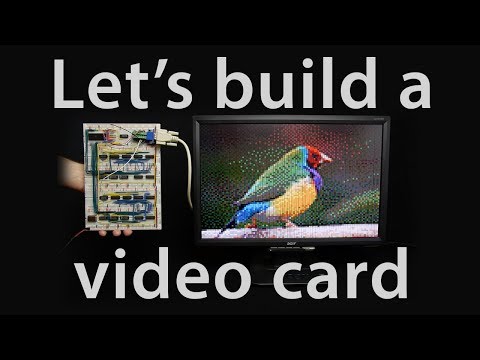
The world's worst video card?
About this video
Ben Eater explains how VGA signals work and builds a breadboard circuit that produces correct sync timing so a monitor recognizes the signal. He then builds toward displaying an image from simple logic chips.
Why it appears in the archive
HN recommends it as a clear, from-scratch look at how video hardware works, understandable with just basic logic knowledge.
AI-generated summary and labels from the source dataset; verify important details against the video. Source & credits.
From the Hacker News discussion
Ben Eater did a video on driving a VGA display using a breaboard circuit. He builds up to it in his usual amazing teaching style, highly recommend: [VIDEO]
Read original comment ↗I'm actually more excited to see a new Ben Eater video on youtube than anything else. His stuff is just fantastic. Even though it's lower level than I've ever worked, it's extremely entertaining and educational. His 6502 series is just great, but I want to highlight another couple of videos he did: "Let's build a circuit that displays an image on a VGA monitor! In this video, I talk about how VGA signals work and build a circuit that provides the correct timing of sync signals so that a monitor recognizes the signal." [VIDEO]
Read original comment ↗Not the same thing, but you reminded me of this since it's in a similar vein. Ben Eater went through the entire process of building a VGA "video card." Anyone with a basic understanding of logic circuits has enough background to understand it. Worth a watch. Part 1: [VIDEO] Part 2: [LINK]
Read original comment ↗Maybe something like Ben Eater's video card series? [VIDEO] If i remember correctly he assembles a gfx card on a bread board. So its fairly fundamental
Read original comment ↗This one might be interesting to you: [VIDEO] “The world’s worst video card?” Ben builds a framebuffer display device on a bread board from scratch, you’ll understand what every transistor does at a high level in an hour (don’t miss part 2). That is abstractly what first principles graphics looked like some time ago - pixels were represented by a block of main memory, and the video system simply scanned that memory at the same frequency as the CRT monitor’s beam. I’d say it’s pretty important to remember that what counts as “first principles” graphics has changed over time, and there was a time before frame buffers (the first Pong game was displayed on an oscilloscope) and the way we use framebuffers today is completely different - there is no more direct access to pixels in the same way old terminals used to work. The article here is detailing how we use a higher level API to draw higher level primitives, and the hardware takes care of the pixels. I’d love to hear a little more about your goal... what’s driving you to study the old terminals?
Read original comment ↗Reminds me of Ben Eater's Youtube videos where he builds everything using basic gates on a breadboard. He made a video-card using ICs on a breadboard that fascinated me: [VIDEO]
Read original comment ↗Even further to that end of the spectrum is "The World's Worst Graphics Card"[1] on a breadboard with mostly discrete logic. Fascinating. [1] [VIDEO]
Read original comment ↗Ben Eater has a great video[1] about building a video card from simple gates and other basic components. It goes into some detail about how a VGA signal is generated. [1]: [VIDEO]
Read original comment ↗