 HackerTube.runGood videos, with context.
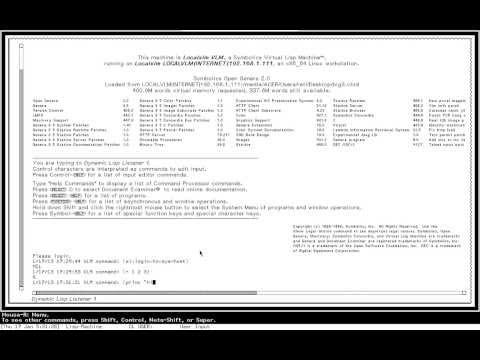
Symbolics Lisp Machine demo Jan 2013
About this video
Symbolics developer Kalman Reti gives a short introductory demo of a Symbolics Lisp Machine running Genera in an emulator. It shows the context-aware command line, typed on-screen objects, and the live-editable system, including swapping in a C-compiled JPEG decoder.
Why it appears in the archive
The go-to demo whenever HN discusses what Lisp machines were like and what modern shells and editors lack.
AI-generated summary and labels from the source dataset; verify important details against the video. Source & credits.
From the Hacker News discussion
See these demos for the kinds of interactive systems LISP enabled back in the day: [VIDEO] [LINK] It makes working on VSCode today look like banging rocks together, let alone 30 years ago.
Read original comment ↗Since he did AI work in the 50's, probably a lot of his work was written in LISP or IPL, which had many of the concepts that LISP later used. Most of his high-profile inventions (Computer mice, Hypertext, Interactive Computers) were first commercialized on LISP machines in the 80s. LISP Machines also pioneered some other concepts such as windowing ystems, graphic rendering, modern networking, garbage collection, etc. There is a fun little demo on youtube here; [VIDEO] . That shows off a LISP machine roughly as it was written in the 80s/90s.
Read original comment ↗There's this recent video showing a little of what the Pharo Smalltalk environment is like: [LINK] The video was made by a Ruby programmer, rather than an experience Smalltalker, so it's more a newbie showing you cool things he's discovered, rather than an expert showing the power of the system. On the other hand, there's this one: [VIDEO] That one is an expert, Kalman Reti, showing some of what it's like to work with a Symbolics Lisp Machine. (It's not a real Lisp machine; they're all at least thirty years old now; this is an emulator running the old Symbolics OS on Linux). Go to YouTube and search for Rainer Joswig and you'll find a few video demos of Lisp Machines and MCL and so forth. Finally, here are a few images from about eighteen years ago, also from Rainer. They show various views of the Macintosh Common Lisp and SK8 environments. It's not an experienced user showing you around, but at least you can get some idea what the environments looked like: [LINK]
Read original comment ↗If you are into Lisp Machines, this talk on Symbolics by Kalman Reti (who worked there) is worth watching (1h): [LINK] If you only have 15 minutes, he gives another demo here: [VIDEO] He has another video where he does some actual hacking (smooth scrolling of sheet music for display while playing an instrument): [LINK]
Read original comment ↗>My dream is to make everything visualizable at runtime. Check out demos of the old Lisp Machines, [1] is a brief overview demo, [2] links to a timestamp with a view of some simple diagramming, but I’ve seen TI-Symbolics beasts routinely display complex relationships in Lisp code on their massive (for the time) bitmapped screens. The limitation was the end user managing the visualization complexity. With open source llvm, clang and similar making available abstract syntax trees and even semantic analysis and type checking results, LLM’s assisting with decompiling binary blobs, and modern hardware (goggles, graphics cards, and so on), I sometimes wonder how close we can come to reproducing that aspect of the Lisp Machine experience on open source operating systems. [1] [VIDEO] [2] [LINK]
Read original comment ↗You mean like the command line on Lisp machines, such as this example from Symbolics Genera? [VIDEO] The command line is contextually intelligent and presents interactive graphics and text. Not a simulation of a teletype on a simulation of a character terminal.
Read original comment ↗This demo appears to be running on an emulator instead of an actual antique piece of hardware but you can get the idea. [VIDEO] the AI winter is something you don't hear too much about. [LINK]
Read original comment ↗I am really curious about how much parsing and formatting occupy *nix source code. (IIRC 30% of ls), and if it would be a good idea to decouple the way you mention it. my json-infused distro is still on my mind. ps: this lisp machine talk mention how 'programs' (I guess functions) exchanged plain old data rather than serialized ascii streams making things very fast. There are caveats of adress space sharing though but it's another nice hint we could investigate other ways. [VIDEO]
Read original comment ↗