 HackerTube.runGood videos, with context.
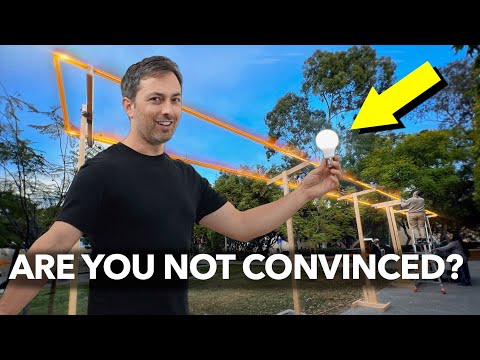
How Electricity Actually Works
About this video
Veritasium explores how electrical energy actually travels in a circuit, arguing that it flows through electromagnetic fields around the wires rather than through the electrons. It builds a long-cable experiment with Caltech to test when a distant bulb lights.
Why it appears in the archive
HN cites it for the field-based picture of power transfer, noting it was controversial at release but the experiment largely backed the creator.
AI-generated summary and labels from the source dataset; verify important details against the video. Source & credits.
From the Hacker News discussion
"How Electricity Actually Works" ( [VIDEO] ) from Veritasium is related and also a fantastic video.
Read original comment ↗The video in question for reference: [LINK] Interestingly, when I saw that I figured this channel for a goner because he was going to turn to the darkside, but quite contrary to expectations I feel like his channel has actually blossomed since then. His older videos are fine, but often just explaining concepts that you can find a lot of other explanations on, but some of his recent videos have rocked the boat even among physicists and IMHO he was ultimately proved to be correct for them. I particularly point at his videos about how nobody has measured the one-way speed of light ( [LINK] ), which was well-known among people very very deep in the field of relativity but not very well known outside of that (even amongst physicists in other fields, let alone lay people) and the electricity videos he's done in the last year ( [LINK] , [VIDEO] ) which attracted a whole whackload of "debunking" videos, which were themselves wrong (the best "bunking" video, if I may call it that, is probably AlphaPheonix's: [LINK] , since he actually set up the experiment, albeit on a smaller scale). They aren't all of that caliber, but the knot theory video was very good too and not something I've seen a hundred times elsewhere, and the airships video that preceded that one clearly had a high degree of research put into it beyond just the hype.
Read original comment ↗Sort of, electricity and magnetism are two sides of the same coin, electromagnetism, so it's waves in the electromagnetic field with the wire acting as a wave guide. (as far as I understand) Veritasium has a video that goes over this. It was pretty controversial at release but it gives a good overview. [VIDEO] And why magnets work due to relativity [LINK]
Read original comment ↗Good intrpduction are Veritasium videos: "How Electricity Actually Works" [VIDEO] "The Biggest Misconception About Electricity" [LINK]
Read original comment ↗You can invalidate the circuit theory with, well perhaps not $50 worth of hardware, but a bit more: [VIDEO] I'm not sure how do you plan to invalidate Maxwell's theory, which shows that energy flows entirely outside of wires, with $50. It would be very much welcome in the physics community. This misconception is even more widespread than "planes fly because of Bernoulli" because it's so incredibly useful when designing most circuits/PCBs. Though it is, fundamentally, a lie. PS. Circuit theory is made to match reality for the case showed in the video via the concept of a transmission line.
Read original comment ↗> Is there any understanding as to why superconductivity breaks down at higher amperage? This is a good read [1] > As long as the induced magnetic field at the edges is less than the critical field, the material remains superconducting, but at higher currents, the field becomes too strong and the superconducting state is lost. This limit on current density has important practical implications in applications of superconducting materials – despite zero resistance they cannot carry unlimited quantities of electric power. Tl;Dr (and probably wrong) as current flows through any conductor it creates a magnetic field. In superconductors when that magnetic field gets too strong it impedes current from being able to flow. A little like a traffic wave [2]. Everything works fine so long as there's enough space between cars to allow for them to speed up and slow down, but as the density of the cars increases if someone slows down that has a reverberating effect down the chain. The magnetic field on a superconductor in turn induces a current on the conductor in the opposite direction. Here's a video discussing some of the implications of this effect in a way that seems counter intuitive :) [3] [1] [LINK] [2] [LINK] [3] [VIDEO]
Read original comment ↗There was a whole mess of STEM YouTubers arguing about this last year, e.g.: [VIDEO] TL;DW: the power is transferred by the electric fields, it's the electric fields which move the electrons, if there's a break in the circuit the electrons necessarily accumulate in the places that minimise the electric fields.
Read original comment ↗In response to all the controversy he made a follow up video [0]. In the video he recreated the experiment, explaining the effect in a more technically correct manner and also apologised for not doing so on the original. He also made it clear that the light globe in the original video did not receive enough current to light up.. it was hooked up to an alternative power source and an oscilloscope and upon receiving any signal above baseline would switch on the globe. [0] [VIDEO]
Read original comment ↗