 HackerTube.runGood videos, with context.
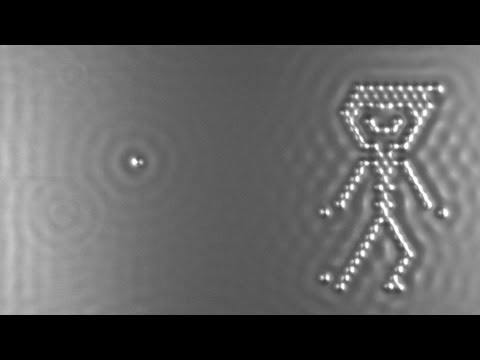
A Boy And His Atom: The World's Smallest Movie
About this video
IBM's record-setting stop-motion film made by moving individual carbon monoxide molecules with a scanning tunneling microscope, illustrating atomic-scale memory research.
Why it appears in the archive
Cited as a striking example of atom-level manipulation and STM imaging, including the ripples viewers ask about.
AI-generated summary and labels from the source dataset; verify important details against the video. Source & credits.
From the Hacker News discussion
The linked video "A Boy And His Atom: The World's Smallest Movie" is entertaining. IBM made a stop-motion animated movie from individual atoms. [VIDEO]
Read original comment ↗I expect it to be about as difficult as this - [LINK] - but not quite as difficult as this - [VIDEO] - or this - [LINK]
Read original comment ↗> I'm not as pessimistic as Bret Victor [...] ABriefRant I'd actually go one step further than that "rant". In the real world, small physical motions usually have little control significance. Mouse movement and keyboards are among the many exceptions. With XR's hand tracking, that can change. For example, while gaming is focused on "feeling like it's real", so game hands overlap real hands, for getting work done, it's nice to have stretchy arms, so you can reach across the room to grab things. For optimal long-term ergonomics, you want a mix - sometimes you want the exercise of waving your arms, and sometimes you want to achieve the same end by merely twitching a hand resting on a knee or keyboard. So not only did the video reduce all of human motion vocabulary, including gaze and voice, down to a single finger over a sad UI, but even that single finger was used in an impoverished manner. ;) > XR will work much better with some pointing and voice input Eye tracking as well. "Look; point; click" has a seemingly redundant step. When someone is watching an education video, say IBM's atom animation[1], you want to both be able to field common questions like "What are the ripples?", but also notice that they are looking at the ripples, and volunteer related content. One can do prototyping now, with WebVR, google speech recognition, and in-browser or google voice synthesis. [1] [VIDEO]
Read original comment ↗> It's mind blowing :) When people watch this[1], and I'm standing next to them, they'll often ask about the ripples. But if they were watching it alone, there isn't an easy way to do that. Someone did an art project, where you sit and watch an interesting drama video. But why was it interesting? There's an eye tracker, and the video is a graph of scenes, like an old "choose your own adventure" story. So if you're interested in character A... the video explores/emphasizes character A. AR/VR is coming. With eye tracking (eventually... patents). So... Imagine science education that's consistently mind blowing, rather than boring. What might that be like? Though a cautionary note: there's apparently a problem of students, who have consistently had excellent teachers, clearly and motivationally presenting material, reaching college without the skills or inclination to themselves wrestle with a body of knowledge and distill understanding. Another opportunity for improvement. :) [1] stop-motion animation with individual molecules: [VIDEO]
Read original comment ↗From the first paragraph of the article: > An atom typically can’t be assigned a definite position, for example — we can merely calculate the probability of finding it in various places. Is this really the case? Or maybe author meant 'electron' instead of 'atom'? I mean, if we wouldn't be able of calculating the position of an Atom, how could "A Boy And His Atom" would be possible? [VIDEO]
Read original comment ↗> but without chemical bonds? Metallic bonds. My understanding is all bonding is atoms sticking together electrostatically, with (insanely fast) "slow" lumbering nuclei, nudged around by their local e-field, and wacky electrons, adopting weird spatial distributions based on the current nuclei positions, setting that field. The bond taxonomy descriptively sorts by characteristics. Here, one is delocalization of valence electrons. Perhaps picture [VIDEO] , STM imaging of cold CO molecules sitting on a copper surface, IIRC. You can't see the individual copper atoms, and there are extended ripples in surface electron density.
Read original comment ↗IEEE VR starts tomorrow (Sunday-Thursday). Entirely online. Registration is waitlisted, until they see how their infrastructure holds up. But they also plan live streaming video of all presentation sessions (papers, panels, workshops, and keynotes) on Twitch, open to anyone. streams: [LINK] schedule: [LINK] hashtag: [LINK] Also working on a video-rich[1] tweet thread "Atoms are {little, balls, sticky, jiggly, bouncy, stacking, etc}", as motivation while working towards an exemplar of transformatively improved science education content, which I hope will speed conversations about that. Anyone have any favorite media of atoms? Also on desktop panning using head tracking. Also on using RealSense t265 tracking cameras with Google Mediapipe's TF hand tracking.[2] Also on a next rev of DIY 3D shutter glasses. Also on... sigh. [1] example media: balls [VIDEO] , sticky [LINK] , ball in the ball (nuclei) [LINK] [2] low-performance browser demo: [LINK]
Read original comment ↗Apropos visualizing atoms and their electrons, here's a fun sidebar. This IBM video[1] was made with an STM scanning tunneling microscope, which sees outer electrons. So while it shows the IIRC carbon monoxide molecules, standing up like buoys, as little balls, the background copper surface of delocalized electrons looks smooth, with ripples. You can't see the individual copper atoms. But if you instead used an AFM atomic force microscope, which can feel inner electrons, then you could - here's one of silicon[2]. When crafting and teaching abstract representations, it's easy to forget that these are real physical objects. [1] [VIDEO] [2] [LINK]
Read original comment ↗