 HackerTube.runGood videos, with context.
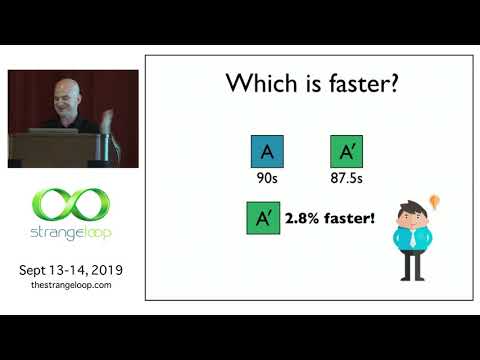
"Performance Matters" by Emery Berger
About this video
Emery Berger explains why performance is hard to measure and deliver on modern hardware, showing how code layout and alignment can swamp optimization effects. He presents Stabilizer for statistically sound evaluation and Coz, a causal profiler.
Why it appears in the archive
It is the standard recommendation for anyone puzzled by unexplained benchmark changes from tiny code edits, and for learning about causal profiling.
AI-generated summary and labels from the source dataset; verify important details against the video. Source & credits.
From the Hacker News discussion
"Performance matters" by Emery Berger on StrangeLoop'19 is a great talk - [VIDEO] Also, rest of his talks are also fascinating: - [LINK] - [LINK]
Read original comment ↗I haven't had a chance to mess around with it much, but the coz-profiler [1] uses basically the same idea, but the other way around (i.e., slow down everything else to get a "virtual speedup") which helps quantify what the effect of optimizing some code would be. I learnt about this tool from Emery Berger's talk [2] on this (at strangeloop), which I highly recommend. Lots of really nice insight, even outside of this tool. [1] [LINK] [2] [VIDEO]
Read original comment ↗Aside: this is the most amazing optimisation information I have seen: [VIDEO] Unfortunate that it is a video... Summary: Modern CPUs have so many hidden causes of performance variation, that you require special tools to actually measure small performance gains. He finds an amazing but unobvious speed up in SQLite using the causal analysis tool they developed. And a surprising difference between -O2 and -O3 implying overfitting.
Read original comment ↗I would highly recommend Emery Berger's talks [1] for anyone interested in benchmarking software. The alignment and code layout in memory that huayra mentions has shockingly large performance implications. [1] [VIDEO]
Read original comment ↗Nobody should do benchmarking like this anymore. Memory layout of your code has such a big impact on performance on modern computers that measuring performance without removing that variable leads to wild goose chases, where you think you improved something, but in reality you incidentally got the compiler to move the code around a bit. Emery Berger has an excelent talk on this [1], and a causal profiler that they developed called Coz[2]. Branch miss-predicts might be somewhat invariant to that, but still, one of the main points of the talk is that people do too much eyeball statistics, mistaking the variance of the underlying stochastic process with actual signal. Coz is pretty trivial to set up with Zig too. 1. [VIDEO] 2. [LINK]
Read original comment ↗This[1] talk from Emery Berger at last year's Strange Loop does a good job discussing the impact of alignment and other 'small' changes on performance, and how to estimate the actual impact of changes on performance [1]: [VIDEO]
Read original comment ↗It's mentioned elsewhere in this HN discussion, but I think I'd encourage watching this talk: [VIDEO] . It's particularly relevant to what you're seeing.
Read original comment ↗Try getting them to watch this talk by Emery Berger: [VIDEO] And who knows, maybe they'd even be interested in using coz afterwards: [LINK]
Read original comment ↗