 HackerTube.runGood videos, with context.
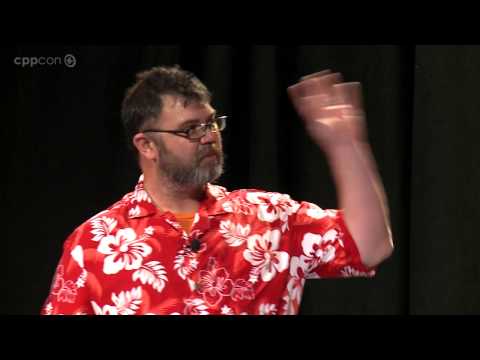
CppCon 2014: Mike Acton "Data-Oriented Design and C++"
About this video
Mike Acton of Insomniac Games argues that a program's purpose is transforming data, and shows how common C++ approaches work against that in performance-critical game development. He covers cache behavior, data layout and the limits of compilers.
Why it appears in the archive
It is the go-to talk HN points to for data-oriented design and hardware-aware performance thinking, despite Acton's blunt style.
AI-generated summary and labels from the source dataset; verify important details against the video. Source & credits.
From the Hacker News discussion
A lot of great talks already mentioned. Thought I'd add a gem from Mike Acton: Data-Oriented Design and C++ [VIDEO]
Read original comment ↗This reminds of an amazing talk by Mike Acton on Data oriented design: [VIDEO] And there is a related talk by Andrew Kelley implementing these ideas on Zig toolchain: [LINK]
Read original comment ↗It clearly didn’t come out of game dev. Many people doing high performance work on either embedded or “big silicon” (amd64) in that era were fully aware of the importance of locality, branch prediction, etc But game dev, in particular Mike Acton, did an amazing job of making it more broadly known. His CppCon talk from 2014 [0] is IMO one of the most digestible ways to start thinking about performance in high throughput systems. In terms of heroes, I’d place Mike Acton, Fabian Giesen [1], and Bruce Dawson [2] at the top of the list. All solid performance-oriented people who’ve taken real time to explain how they think and how you can think that way as well. I miss being able to listen in on gamedev Twitter circa 2013 before all hell broke loose. [0] [VIDEO] [1] [LINK] [2] [LINK]
Read original comment ↗I'm going to disagree with most of the comments here which say that you can't become faster, as I have become notably faster over the past couple of years (perhaps 1.5-2x faster!!). Basically, it was a fairly major coding style change that happened after working with others in my industry (game development) and seeing their prolific output of high quality code. My process for writing code used to be: - Identify problem. - Identify the abstractions that fit the problem - Implement those abstractions - Write code to solve problem using those abstractions. Now it is - Identify problem. - Write code to solve problem, pulling abstractions out if and only if they make sense and would actually be used . Honestly, I feel this leads to much better, cleaner and more understandable code, however, it tends not to mesh well with what some people consider best practices. The resulting code tends to not be particularly object oriented, tends to have large functions, and tends to perform very well due to having a very small distance from what the code says to what actually needs to be executed by the processor. For more on this approach, see [0]: [LINK] [1]: [LINK] [2]: [VIDEO]
Read original comment ↗Just because it's asm doesn't mean it's fast, sure. Just because it's C doesn't mean it's faster than an implementation in your favourite scripting language. Having said that, compilers do pretty badly on C-to-simd optimisation. The best you get is loop vectorization if it's really simple logic. You can usually get some pretty good wins there. The fact you lay out your memory for simd usually is a win all of its own due to cache prefetching even if you don't actually use any simd instructions. Compilers need heuristics to manage cache when you know what you're trying to do, (eg when should it use non-temporal writes, for example?) Fast C code is written while having a really clear mental model of the underlying architecture and the assembly that the C will produce with -O3 (or whatever flag is relevant to your compiler) and then checked with -S or objdump -D, profiled with callgrind/cachegrind, perf, rdtsc etc... The compiler really can't "Do it for you" You /can/ use a compiler as one of your tools when /you/ do it. As Randy Hyde points out you can always beat the compiler because you can use its generated assembly language in every case you can't beat, so the absolute worst you get is a tie. So yeah, you can totally smoke clang, Intel, microsoft and gnu C compiler and get paid something for doing it in certain industries too. :-) Mike Acton being aggressively opinionated on the subject, but the lecture is really good (despite/because of) the bits you'll disagree with and th
Read original comment ↗A great talk which gets you thinking in this mindset is "Data-Oriented Design and C++" by Mike Acton [VIDEO] As an example, if you are checking a boolean flag (1 bit) on an object, and it ends up being a cache miss (and x86_64 cache line size is 64 bytes), then your computer just went through all the expense of pulling in 512 bits from RAM yet it only used 1 of them. You are achieving 0.2% of the machine's possible throughput.
Read original comment ↗I think this is a valid critique. But then, most of the development (C aside) has been a victim to OOP. I have begun to think that OOP creates more problems than it solves. Added complexity and performance loss being the biggest. It's insane if you peek into a big projects where many developers came and went and each of them read an article about what it seemed an interesting design pattern and tried to implement them. You can have some kind of procedural programming if you use classes just to store data and use static methods. But the frameworks are OOP and there is no way around that unless you write your own frameworks. I am a big fan of Mike Acton's Data Oriented Architecture speeches, but I didn't find a way to implement something similar in C#. For those interested in something better than OOP, here's a few links: [VIDEO] [LINK] [LINK]
Read original comment ↗Mike Acton presented a great visualization of this in his 2014 DOD talk -- here's a link to just that clip: [VIDEO]
Read original comment ↗