 HackerTube.runGood videos, with context.
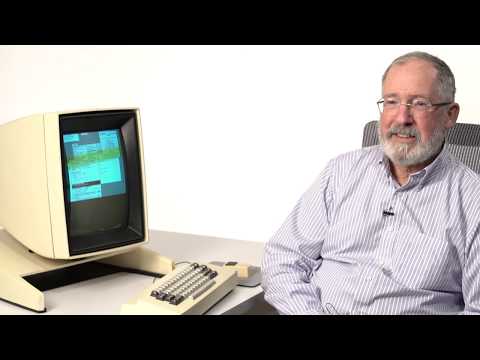
Alto System Project: Dan Ingalls demonstrates Smalltalk
About this video
A roughly two-hour demonstration by Dan Ingalls of Smalltalk running on the Computer History Museum's restored Xerox Alto. It shows the integrated environment and language designed at Xerox PARC as personal dynamic media.
Why it appears in the archive
Recommended as a vivid look at live, interactive programming environments and what Xerox PARC built on very limited hardware.
AI-generated summary and labels from the source dataset; verify important details against the video. Source & credits.
From the Hacker News discussion
Since the talk was already posted yesterday, here's another great related video that is well worth watching: Dan Ingalls demonstrating Smalltalk 76 on a restored Xerox Alto. [VIDEO] This is where it all started and it's truly amazing what they achieved on such limited hardware.
Read original comment ↗Anything based on the workstation concepts explored at Xerox PARC, and further pursued at ETHZ, TI and Genera. Bitsavers has all the necessary papers and manuals, and computer museum as well. Here are some video sessions. "Yesterday's Computer of Tomorrow: The Xerox Alto │Smalltalk-76 Demo" [LINK] "Alto System Project: Dan Ingalls demonstrates Smalltalk" [VIDEO] "Eric Bier Demonstrates Cedar" [LINK] "The Final Demonstration of the Xerox 'Star' computer" [LINK] The end of the road from Plan 9, Inferno. [LINK] [LINK]
Read original comment ↗Be prepared to be amazed with what Xerox PARC and others were doing, while Bell Labs was busy pushing for UNIX. "Eric Bier Demonstrates Cedar" [LINK] "Emulating a Xerox Star (8010) Information System Running the Xerox Development Environment (XDE) 5.0" [LINK] "Documents as User Interfaces Video Demo" [LINK] "SYMBOLICS S-PACKAGES 3D GRAPHICS AND ANIMATION DEMO" [LINK] "Alto System Project: Dan Ingalls demonstrates Smalltalk" [VIDEO] "Action!, the worlds first dynamic interface builder - 1988" (Interface Builder percursor, written in Lisp) [LINK] "The Interlisp programming environment" [LINK] And the cherry, how Lucid used Lisp ideas for their Energize C++ IDE, including an image based format for AST storage [LINK] [LINK]
Read original comment ↗I’ve been on a Smalltalk binge the last few days and have really been enjoying this two hour long interview / demo with Dan Ingalls on Smalltalk and the Alto: [VIDEO]
Read original comment ↗It is a bit hard to explain in an HN comment something that requires live experience, You can start by having a look at, [LINK] "Eric Bier Demonstrates Cedar" [LINK] "Alto System Project: Dan Ingalls demonstrates Smalltalk" [VIDEO] "SYMBOLICS CONCORDIA ONLINE DOCUMENTATION HYPER TEXT MARKUP 1985" [LINK] You can see how NeXT builds on many of these concepts on the famous "NeXT vs Sun" marketing piece, [LINK] Sun also had some ideas along these lines with NeWS, "NeWS: A Networked and Extensible Window System," [LINK] Naturally OS/2, BeOS, Windows, macOS, iOS, and even Android share some of the ideas. Now, before I proceed note that actually modern Linux distributions have all the tooling to make these concepts happen, but it fails short to have everyone agree on a proper stack. So basically, the main idea is to have a proper full stack in place for developing a Workstation computer as one single experience, from bottom all the way to the top. On Xerox's case, they used bytecode with in-CPU execution via programmable microcode loaded on boot, and later on just a thin native glue on top of host OS. The environments had frameworks / modules for the whole OS stack, supported distributed computing, embedded of data structures across applications (OLE can trace its roots back to these ideas), REPLs that not only could interact with the whole OS (commands, modules, running applications), it was also possible to break into the debugger, change the code and redo the failed instructions.
Read original comment ↗Bravo was modal, Gypsy was non-modal, Smalltalk-74 onwards had multi-windows (including pop-up menus) and a metaphorical desktop. I assume you know these interesting presentations: [LINK] , [VIDEO] EDIT: see also e.g. [LINK]
Read original comment ↗The ideas he's promoting aren't new, and in fact predate even the NES. They date back to Smalltalk, which was created at Xerox PARC in the 1970s: [VIDEO]
Read original comment ↗You won't get any reliable numbers during wartime. I heard Ukrainian government recently mention they ordered a million. Hundreds of small companies (around 10 employees each) in Ukraine are making and assembling drone's right now (according to journalists who filmed them in Ukraine last month). I counted at least two dozen companies in the Netherlands, probably a few hundred all over Europe. Besides the frame that holds the 4 or six rotors together all other parts are off the shelf, mostly ordered from Shenzen. You can CNC mill a carbon fiber or aluminum frame from a single plate on an x-y flatbed cnc. I researched all this last night because I need $20K-$200k investment right now to start my own startup making unjammable autonomous kamikaze drones with 20K payload on top of 20km optical fiber spools unreeling. I think it is possible to make them lighter without fibers if you put a few thousand microprocessors in with a wafer scale integration for $500. Of course you could just make cheap drones that kill every warm body in sight[4] indiscriminately. To disable a tank you need these fiber tethered drones with bigger payloads[3][5][6]. You cab see two fiber strands still in the air in a few frames of the video. What you need is a Paul MacCready style development cycle for drones in the field. You need to be able to make 10 crashes per hour, fix the drone by replacing with off-the shelf components and try again. The programming should be live-coding like Squeak Smalltalk, no r
Read original comment ↗