 HackerTube.runGood videos, with context.
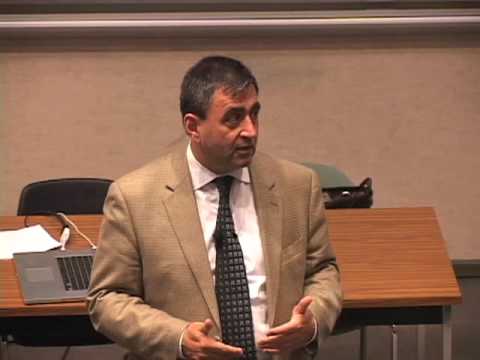
Confessions of a Converted Lecturer: Eric Mazur
About this video
Harvard physicist Eric Mazur explains how he realized his students were memorizing rather than understanding, and how he changed his teaching. He presents peer instruction and data showing improved student performance.
Why it appears in the archive
Repeatedly recommended in education threads as the definitive talk on why lectures fail and what works better.
AI-generated summary and labels from the source dataset; verify important details against the video. Source & credits.
From the Hacker News discussion
Strongly reminiscent of this really fantastic talk from Eric Mazur, a Harvard physics professor (and a charismatic speaker!) who was shocked when he discovered the pervasive misconceptions held by his undergraduate students. [VIDEO] Mazur describes how he discovered and carefully measured the lack of fundamental understanding among the majority of his students, and how after attempting to address the problem in various ways, he found that a discussion-based, peer-assisted method of working through material was much more effective than more a lecture-oriented approach.
Read original comment ↗Great video on how a pretty good teacher (as conventionally measured) learned how to really teach. [VIDEO] titled: Confessions of a converted lecturer.
Read original comment ↗I strongly disagree with the notion that college algebra ought to be the place where one learns practical applications of mathematics. A valuable skill for any educated person is the ability to plod through minutia and make sense of it. Being able to be focused on the point at hand and not let distractions cloud judgment is a valuable skill. If one really understands the mechanics of logs then I think they will not freak out when presented with a formula involving logs. I'm all in favor of applications but isn't this the job of other subjects? The applications should be taught in the subjects that apply it. The goal of a mathematics class ought to be to understand mathematics. This lecture, [VIDEO] is long but well worth watching. He provides strong evidence that students learn to solve word problems but haven't the slightest idea of what is really going on. They are memorizing steps. This happens at Harvard and the community college. I've given my students the standard word problems on travelling problems. They get the problems right. Then I ask them this simple problem and they universally get is wrong: You drive 1 mile at 40 mph and then the next mile drive 60 mph. What is your average speed? (Almost everyone says 50 mph.) We aren't teaching thinking skills. We are teaching memorization of problem types. Almost none of them is actually practical, correct, or useful. But why are we teaching travelling problems in a math class? I think it should be taught in physics.
Read original comment ↗In a similar vein, there's a really great talk by Eric Mazur, Physics professor at Harvard about peer instruction — [VIDEO] He goes into why he started exploring the idea at first (students got 5's on their AP physics exams and had strong problem-solving skills — plug-and-chug — but poor conceptual understanding), the many iterations of the approach, and the data he collected on the way (significant increases in open-ended, conceptual problems, including at other schools that adopted the approach). Really fascinating. I haven't watched the shorter version, but someone edited they key points down to 18 minutes: [LINK]
Read original comment ↗> At the end of this (i.e. graduate level courses) the only ones with sufficient mastery are those that are doing the research. Sadly, sufficient mastery of the subject often comes at the cost of sufficient mastery of teaching , which becomes especially important for such difficult subjects. If only some of that money spent on more staff was spent on assistant teachers whose main skill was teaching and coaching other teachers, and providing paid hours for both of them to fix the curriculum together... Anyway, I fully agree with your second paragraph. Another issue is that of researchers not really seeming to care, having an attitude of "you shouldn't be in University unless you really want to learn this, and I'm not going to try to motivate you or help you with that." There's some truth to that, but it also sometimes feels like it's used as a way to mask their own teaching incompetence. I was asked to be an assistant teacher after graduating from my masters, and I completely freaked out about the responsibility of making sure I wouldn't fuck up my student's education (I cared more than most of my students did). I almost declined the job offer! I was basically told "yeah we know, that's part of why we want you." Anyway, I spent a lot of time on-line trying to find advice on the dos and dont's of education. I can say that the best two lecture were Eric Mazur's Confessions of a Converted Lecturer [0] and John Corrigan's Are We Listening To Our Children? [1]. I think every teache
Read original comment ↗A better question would be: what percentage understand what a random variable is and will be able to apply this understanding later. See [VIDEO] for exploration of the difference by a Harvard physics professor who realized a few years into his teaching career that most of his into physics students weren't learning very much, although they were able to apply all the appropriate mathematical recipes to all the standard type homework and exam questions.
Read original comment ↗Eric Mazur's Peer learning process [VIDEO] kind of highlights the problem and a solution for the same. Namely, Flip the classroom. Ask questions that highlight the knowledge gap within the students. Let students debate among themselves and then actually provide the solution. Though this is not sufficient, it at least improves the ability of the student to reason about the problem and question the models they have built around their heads on the given subject.
Read original comment ↗You are correct that course sizes matter to educational outcomes for a variety of reasons. If the groups are too small, it is possible that nobody has enough of what is needed for the class and everybody flounders, requiring intensive instructor led tutoring and learning. This brings us back to the 1:1 situation. If we are interested in how many students are required to support peer to peer learning, you might enjoy the following articles (popular and academic) about how Harvard physics professor, Dr. Eric Mazur has embraced and studied peer-to-peer instruction. This should provide a partial answer to your questions. 1) Eric's Harvard Profile [LINK] ) 2) A good story/video about the development of his peer-to-peer, active learning methods ( [VIDEO] ). 3) One of Harvard's articles about his educational work. ( [LINK] 4) A list of Dr. Mazur's publications ( [LINK] ) 5) Eric's 2015 papers on peer learning a) 2015 - Dowd JE, Araujo I, Mazur E. Making sense of confusion: Relating performance, confidence, and self-efficacy to expressions of confusion in an introductory physics class. Physical Review Special Topics - Physics Education Research. 11. DOI: 10.1103/PhysRevSTPER.11.010107 b) 2015 - Miller K, Schell J, Ho A, Lukoff B, Mazur E. Response switching and self-efficacy in Peer Instruction classrooms Physical Review Special Topics - Physics Education Research. 11. DOI: 10.1103/PhysRevSTPER.11.010104 Googling for "ideal group size for peer to peer learning physics" brings up arti
Read original comment ↗