 HackerTube.runGood videos, with context.
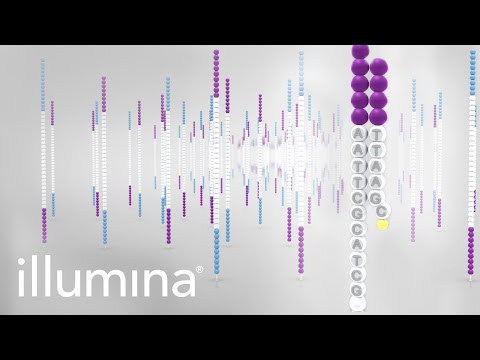
Overview of Illumina Sequencing by Synthesis Workflow | Standard SBS chemistry
About this video
Illumina's 3D animation of its sequencing-by-synthesis workflow, from sample preparation and cluster generation to sequencing on a flow cell and data analysis.
Why it appears in the archive
Commenters call it the best visualization of how the most common DNA sequencers work, though it predates newer chemistry.
AI-generated summary and labels from the source dataset; verify important details against the video. Source & credits.
From the Hacker News discussion
[VIDEO] is the best visualization of how the most popular type of DNA sequencer works (that I've found). Imagine you have a string of length 3 billion made by randomly choosing from 4 characters. Like this dna = ''.join(random.choices('atgc', weights=[30.9, 29.4, 19.9, 19.8], k=3_234_830_000)) you get to randomly sample 1 billion[3, page 7] overlapping substrings of length 200[3, page 7] with .1% of the characters randomly changed[3, page 8]. Trying to find the original string from this is technically an undecidable problem. If there's a sequence 400 characters long that repeats multiple times, how could you know if it repeats 5 times or 50 times? (this would be unlikely to happen with random.choices() but DNA isn't random). This is called sequence alignment and it's one of the hard problems in bioinformatics[4]. [0] [LINK] random.choices() was added in Python 3.6 [1] [LINK] source for `weights` [2] [LINK] source for 3_234_830_000 (python ignores underscores in numbers) [3] [LINK] illumina is the most popular producer of genome sequencers [4] [LINK]
Read original comment ↗That video describes the process used before NGS was around. These days, using anything with plasmids would be pretty unusual. There are several next generation sequencing technologies: 1) short read - Illumina - dominates most next-generation sequencing 2) long read - nanopore or pacbio. These have very different analysis methods, have measurement errors that are very different, and even have different file formats, etc. Short read is far more common, so you're probably in the "Data Analysis" of this: [VIDEO] But you need to know about the adapters and indices (how multiple samples can be sequenced at the same time). But as another commenter mentions, knowing some particulars about the project would really help know what sort of tutorial would be appropriate. You'll need to also know about the biology of the application, in addition to understanding the sequencing technology.
Read original comment ↗A sequencing run (at least in the context of Illumina's technology) requires a few very expensive consumable reagents: First being the flowcell (microscope slide that the dna sticks to while being read by a laser), the reagents (containing enzymes with fluorophores and other reagents for amplifying and manipulating DNA), and the actual power consumed by such machinery. This does not factor in prep/lab costs (which can be kept at a minimum with automation, but that also is a high startup cost endeavor). Each sequencing run can take ~1-3 days depending on the format. Edit: this video may be able to explain a little better how this process works: [VIDEO]
Read original comment ↗