 HackerTube.runGood videos, with context.
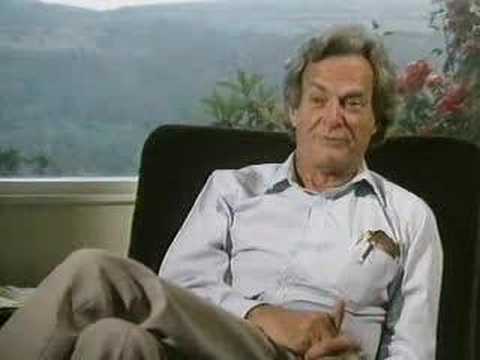
Feynman :: Rules of Chess
About this video
A three-minute clip of Richard Feynman using the rules of chess as an analogy for how science works, discovering rules by observation and sometimes meeting surprises like castling. It touches on incremental progress versus revolutions.
Why it appears in the archive
Cited in discussions of the scientific method and empiricism as Feynman's classic analogy of watching a game to infer its rules.
AI-generated summary and labels from the source dataset; verify important details against the video. Source & credits.
From the Hacker News discussion
>It's nonsense, top-to-bottom. This isn't a formal physical theory, just a heuristic for evaluating lines of investigation. Richard Feynman gave a good explanation of the principle, which he said he found helpful in his work. [VIDEO]
Read original comment ↗Science is a blackbox. We make theories about the world we live in based upon the results of experiments. Richard Feynman commented method of thinking about science on one of his videos. [VIDEO]
Read original comment ↗I suspect the metaphor is inspired by Feynman's one about gods playing chess [1]. As it's almost always the case, Feynman manages to immediately inspire and illuminate. On the other hand, the present article seems to me to get some important things wrong. For one, it's not the case that overall white and black win 50% of the time each. More importantly though, if somebody is interested in investigating chess, they will supposedly understand that it's some activity that other (somewhat) intelligent beings are undertaking. Even if everything seems like a blur, an alien scientist should not be content with dismissing it as uninteresting randomness. More so, if somebody actually starts investigating seriously, they will immediately obtain useful results about the game, results that should almost certainly provide useful predictions about the game outcome (at least better than "it's all random"). I might find, however, some agreement with the spirit of the article. It seems to me that, even though the author doesn't articulate it properly, the idea is that scientists should pursue more fringe theories even if immediate confirmation is lacking. I think there's quite a bit of value in this, as long as your predictions are always checked against reality. [1] [VIDEO]
Read original comment ↗> that we cannot use empiricism to determine universal rules, we indeed cannot do this and Feynman illustrated this frequently using the analogy of chess ( [VIDEO] ). As Kant argues we can never observe the rules of the physical world as things in themselves, just as we can't directly look at the rules of chess by observing games. We can only get individual hints that we piece together into models of the world in ways we can understand.
Read original comment ↗