 HackerTube.runGood videos, with context.
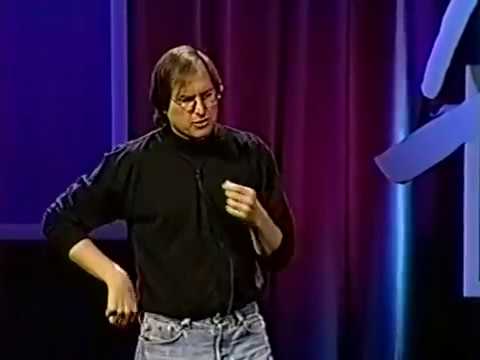
Steve Jobs Insult Response - Highest Quality
About this video
A clean-audio clip from Apple's 1997 WWDC where Steve Jobs answers a hostile question from a developer about OpenDoc. He argues you must start with the customer experience and work backwards to the technology.
Why it appears in the archive
Quoted constantly as the canonical statement of product-first thinking over technology-first thinking, and as a model of handling a heckler.
AI-generated summary and labels from the source dataset; verify important details against the video. Source & credits.
From the Hacker News discussion
For those interested, AllAboutSteveJobs.com keeps a pretty good repository of Jobs moments. My personal favorite is his 1997 WWDC talk [1]. In one talk he demonstrates what it is to be a great leader organizationally, publicly, and as a product visionary. He also opens himself up to harsh criticism from people who were, in a lot of ways, rightfully pissed at him. He takes both tough questions and ad hominem attacks gracefully and reframes the narrative in a positive way without disparaging the questioner [2]. To me, this is in stark contrast to the staged events with canned/screened questions that most tech leaders run today. He also lays out much of the vision for products that are still being rolled out 10-20 years later. Crazy. Really recommend watching the full thing if you have time, but also linking to a little excerpt from one of the best moments. [1] (full video): [LINK] [2] (insult excerpt): [VIDEO]
Read original comment ↗[VIDEO] The libre/open app issue has been brought up by Apple nay-sayers for time immemorial; Steve Job's response is brilliant here, frankly quite timeless and ultimately (in my view) apropos. "You've gotta start from the customer experience and work backwards to the technology."
Read original comment ↗Most of the people who worked directly under Steve Jobs knows he is an Asshole. At the same time they all loves him. You may want to watch [1] Steve Jobs Insult Response. And you can imagine most people are the guy asking that question. [1] [VIDEO]
Read original comment ↗All in the name of UI cleanliness and simplicity . Like how there's no way to manually trigger the firmware update for the AirPods. You just have to keep them plugged in next to your iPhone and ... wait ... until some magic pixie in Apple's cloud decides it's time to push the update to you. Steve Jobs used to say it over and over again when criticized by angry developers[1] that their main focus will always be users instead of developers and that the latter will just have to suck it up if they want to get a piece of the lucrative Apple user base pie. In comedic contrast, here's a sweaty Steve Balmer shouting "Developers!" for half a minute.[2] Ah, the early 2000's, with Apple and Microsoft battling it out, what a time to be alive. [1] [VIDEO] [2] [LINK]
Read original comment ↗i can't advise you on what to do -- but i have opinions on things! i think being somewhat educated about tech and programming can be a help as a founder, but only to a certain extent. and even if you're a techie, you won't necessarily know how to be a good manager of an outsourced project. i've learned a bit over the years, but am still a newbie. i've never seen a single quality article, here or at any other site, that talked about HOWTO outsource a project well. other downsides to being a techie is that you start paying attn to tech instead of solutions to problems. way i see it, you build something, then you find/hire someone to help you take it over, maintain it, improve it, fix it, expand it, throw it away and build again, whatever. if you built some site that was becoming successful, and it was complete trash that nobody could work on, or it just coudln't scale enough, or whatever -- then you've got a great fucking problem on your hands -- you've got traffic and/or a business -- most people never get that far. now just do what is necessary, including throwing away what you have at that point if you have to. other advice -- you'll burn out on programming one day and won't want to do it ever again, and it will jump on you and you'll be like, 'shit'. so, i would suggest waiting around to form some SUPERBUSINESS might not be the best stategery. if you care about maintainability of your code, then that puts you in the top 1% of contractors. the sum-up -- being a techie, on th
Read original comment ↗Much of what Joel says here - especially the conclusion at the end - is also mirrored in what Steve Jobs said when confronted over shutting down OpenDoc: "You have to start with the customer experience and work backwards to the technology. You can't start with the technology and figure out where you're gonna sell it." [VIDEO]
Read original comment ↗That was the vision of OpenDoc, and the component based CyberDog web browser that Apple built with it. [LINK] >OpenDoc is a defunct multi-platform software componentry framework standard created by Apple in the 1990s for compound documents, intended as an alternative to Microsoft's proprietary Object Linking and Embedding (OLE).[1] It is one of Apple's earliest experiments with open standards and collaborative development methods with other companies. OpenDoc development was transferred to the non-profit Component Integration Laboratories, Inc. (CI Labs), owned by a growing team of major corporate backers and effectively starting an industry consortium. In 1992, the historic AIM alliance launched between Apple, IBM, and Motorola—with OpenDoc as a foundation. With the return of Steve Jobs to Apple, OpenDoc was discontinued in March 1997. [...] >After three years of development on OpenDoc itself, the first OpenDoc-based product release was Apple's CyberDog web browser in May 1996. The second was on August 1, 1996, of IBM's two packages of OpenDoc components for OS/2, available on the Club OpenDoc website for a 30 day free trial: the Person Pak is "components aimed at organizing names, addresses, and other personal information", for use with personal information management (PIM) applications, at $229; and the Table Pak "to store rows and columns in a database file" at $269. IBM then anticipated the release of 50 more components by the end of 1996.[7] WWDC 1996 Cyberdog demo [LIN
Read original comment ↗Musk is right in wanting "high velocity of features," i.e., the ability to evolve Twitter faster. How deeply he understands the technical details does not matter that much, as long as he has capable technical people working with him. It's likely that they are the ones telling Musk they need to rewrite big chunks of Twitter's infrastructure. Given that WhatsApp was able to grow to ~500 million users with only 32 employees, it's quite possible they're right. I'm reminded of this confrontational interaction between a technical person and Steve Jobs: [VIDEO] -- in hindsight, Jobs was right : "You've got to start with the customer experience and work backwards to the technology," not the other way around.
Read original comment ↗